How to Prevent Algae, Mold, and Dark Streaks on Your Florida Roof
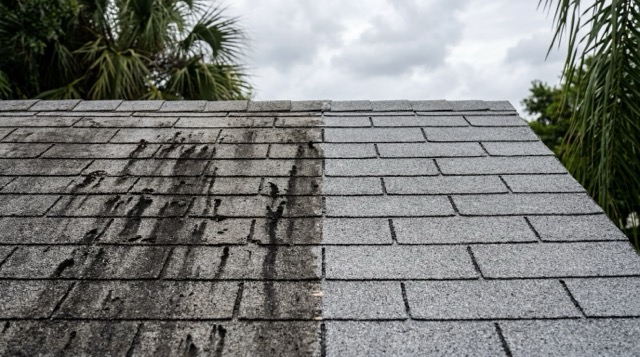
Those black streaks running down your roof are Gloeocapsa magma, a blue-green algae that feeds on the limestone filler in asphalt shingles. It’s not dirt, it’s not mold, and it’s not just a cosmetic problem. This algae creates a dark protective coating that absorbs heat, accelerates shingle degradation, and shortens your roof’s lifespan. In Florida’s humidity, it’s not a question of if your roof will get it — it’s when.
Table of Contents
- What Are Those Black Streaks on Your Florida Roof?
- What’s the Difference Between Roof Algae, Mold, Moss, and Lichen?
- How Do You Safely Clean Algae Off a Florida Roof?
- How Can Florida Homeowners Prevent Algae from Coming Back?
- When Do Dark Streaks Mean Your Roof Needs More Than Cleaning?
- What SCM Roofing Recommends
- Frequently Asked Questions
- Key Takeaways
What Are Those Black Streaks on Your Florida Roof?
Gloeocapsa magma is a species of cyanobacteria (blue-green algae) that has become the single most common roof staining problem in the southeastern United States. It feeds on the calcium carbonate in limestone filler — an ingredient used in most asphalt shingles manufactured today.
The algae itself is actually blue-green, but it produces a dark outer coating to protect itself from UV radiation. That dark coating is what you see as black streaks running down your roof from the ridge toward the eaves. The streaks follow water flow patterns because the algae spreads through rainwater runoff.
Here’s why it matters beyond appearance: that dark coating absorbs significantly more heat than clean shingle surfaces. Your attic temperature rises, your cooling costs increase, and the shingles themselves degrade faster because they’re running hotter. Over time, the algae also breaks down the granule bond on your shingles, causing premature granule loss. Lost granules mean less UV protection for the asphalt underneath, which accelerates aging.
Florida’s Gulf Coast is essentially a perfect incubator for this algae. Humidity levels regularly exceed 80%, afternoon thunderstorms provide constant moisture, and warm temperatures year-round keep the algae actively growing. North-facing roof slopes are the worst because they get less direct sunlight and stay damp longer.
If you drive through any neighborhood on the Gulf Coast — from Clearwater to Cape Coral — you’ll see dark streaks on a majority of shingle roofs over five years old. It’s that prevalent.
What’s the Difference Between Roof Algae, Mold, Moss, and Lichen?
Homeowners often use these terms interchangeably, but they’re different organisms that require different treatments.
Algae (Gloeocapsa magma): Appears as flat, dark streaks running vertically down the roof. It’s the most common issue in Florida. It’s not fuzzy, not raised, and not green. The dark staining is relatively smooth against the shingle surface.
Mold: Appears as fuzzy or powdery patches, often in shaded areas. Mold is a legitimate health concern because spores can enter your attic and get pulled into your HVAC system. If you see mold on your roof, check your attic for moisture problems and mold growth on the underside of the deck. Mold on a roof often indicates a ventilation or moisture problem underneath.
Moss: Thick, green, carpet-like growth that develops in heavily shaded, moist areas. Moss is the most structurally damaging because its root system grows under shingle edges and lifts them. Once shingles are lifted, water gets underneath and damages the deck. Moss is less common in sunny Gulf Coast neighborhoods but shows up under heavy tree canopy — think live oaks and mature landscaping in older neighborhoods.
Lichen: A crusty, pale green or gray organism that’s actually a combination of algae and fungus living together. Lichen embeds into the shingle surface and is the hardest to remove without damaging the granules. If lichen is widespread, the shingles are often too far gone for cleaning to help.
Each of these thrives in Florida’s warm, humid climate. The key difference for homeowners: algae is mostly a degradation and cosmetic issue, mold is a health concern, moss causes structural damage, and lichen usually signals shingles that need replacement.
How Do You Safely Clean Algae Off a Florida Roof?
The single most important rule for cleaning algae off an asphalt shingle roof: never use a pressure washer. This is worth repeating because it’s the most common mistake homeowners make.
Pressure washing strips granules off your shingles. Those granules are the UV protection layer that determines how long your shingles last. Blast them off with a pressure washer and you’ve just taken years off your roof’s lifespan. Every major shingle manufacturer — including GAF — states that pressure washing voids the warranty.
The correct method is soft washing: a low-pressure application of a cleaning solution that kills the algae without damaging the shingles. Here’s how it works:
The cleaning solution is typically a bleach-based mixture — the Asphalt Roofing Manufacturers Association (ARMA) recommends a 50/50 mix of household bleach (sodium hypochlorite) and water. Some professional roof cleaners use proprietary solutions with surfactants that improve coverage and reduce runoff onto landscaping.
The solution is applied at low pressure (no more than what a garden hose produces) and allowed to sit for 15 to 20 minutes. The bleach kills the algae. Then the roof is rinsed gently with low-pressure water. The dead algae washes away over the next few rain cycles.
Best time to clean: Overcast days or early morning. The solution needs dwell time, and direct Florida sun can cause it to evaporate before it does its job. Late fall through early spring works well because the algae growth slows and humidity is slightly lower.
Professional vs. DIY: Professional soft washing runs $300 to $600 for a typical Gulf Coast home. DIY is possible but involves working on or near the roof with chemicals, which carries fall risk and the risk of damaging landscaping if the runoff isn’t managed.
How Can Florida Homeowners Prevent Algae from Coming Back?
Cleaning kills existing algae, but it comes back in Florida’s climate unless you take preventive steps.
Zinc or copper strips at the ridge line. Metal strips installed along the roof ridge release zinc or copper ions every time it rains. Those ions wash down the roof surface and create an environment that inhibits algae growth. This is one of the most effective long-term prevention methods. The strips are inexpensive — $50 to $150 in materials for a typical home — and can be installed during any roof maintenance visit.
Algae-resistant shingles (AR shingles). GAF’s StainGuard Plus technology incorporates copper-containing granules directly into the shingle. These granules slowly release copper over time, preventing algae colonization. If you’re getting a new roof in Florida, AR shingles are a no-brainer. The cost premium over standard shingles is minimal — typically $200 to $500 for a whole roof — and the protection lasts the life of the shingle.
Tree trimming for sunlight. Algae thrives in shade and moisture. Trimming tree canopy to allow more sunlight on your roof, especially north-facing slopes, significantly reduces algae growth. Live oaks, laurel oaks, and mature palm canopies are the biggest culprits on the Gulf Coast.
Improve attic ventilation. Proper ridge and soffit ventilation reduces moisture buildup under your roof deck. Less moisture means a less hospitable environment for algae, mold, and moss on the surface above. If your attic feels like a sauna in the summer, your ventilation needs attention.
Annual soft wash schedule. For homes already prone to algae in heavily shaded areas, an annual soft wash keeps growth under control before it becomes severe. This is maintenance, not repair, and it’s far less expensive than the shingle damage that untreated algae causes over time.
When Do Dark Streaks Mean Your Roof Needs More Than Cleaning?
Algae cleaning works when the shingles underneath are still in good condition. But there’s a point where the damage has gone too far.
Excessive granule loss in gutters. Check your gutters after a rain. Some granule loss is normal on any shingle roof. But if you’re finding heavy accumulation of granules — looking like coarse sand — the shingles are deteriorating. Algae accelerates this process, and once the granules are gone, cleaning the algae doesn’t restore the UV protection.
Shingle curling or cupping. When shingle edges curl upward or the center cups, the shingle’s structural integrity is compromised. Algae-related heat absorption accelerates curling. Cleaning won’t flatten a curled shingle.
Soft spots on the roof deck. If you can feel soft spots when walking the roof (which only a professional should do), moisture has penetrated the deck. This goes beyond algae on the surface — it means water has been getting through, possibly through moss-lifted shingles or deteriorated flashing.
Visible underlayment or deck. If you can see the black underlayment or bare wood through missing granules and deteriorated shingle surfaces, the roof covering has failed. No amount of cleaning changes that.
When these signs are present, the conversation shifts from cleaning to replacement. That’s actually a good thing — it means the next roof can include algae-resistant shingles that prevent the problem from the start.
What SCM Roofing Recommends
In Florida, algae is a when-not-if situation for shingle roofs. We see it on virtually every roof inspection across the Gulf Coast, from brand new neighborhoods in Lakewood Ranch to established communities in Fort Myers.
For any reroof project, we recommend algae-resistant shingles as standard. GAF’s StainGuard Plus line uses copper-bearing granules that prevent algae growth for the life of the shingle. The cost difference is minimal compared to the maintenance savings and extended curb appeal over 20+ years.
During any roof inspection, SCM Roofing checks for biological growth as part of our standard assessment. We’ll tell you whether what you’re seeing is cosmetic algae that can be cleaned, structural moss that needs treatment, or deterioration that requires repair or replacement.
As a GAF Master Elite certified contractor, we have access to the full range of GAF’s algae-resistant product lines and can specify the right shingle for your home’s specific conditions — shade level, orientation, and proximity to moisture sources.
The most common mistake we see: homeowners ignoring dark streaks for years because they think it’s just cosmetic. By the time they call, the algae has accelerated granule loss to the point where the shingles are past their useful life. Annual maintenance is far cheaper than a premature reroof.
---
Frequently Asked Questions
Q: Can I pressure wash algae off my Florida roof?
A: No. Pressure washing strips protective granules from asphalt shingles, voids manufacturer warranties, and shortens your roof’s lifespan. The correct method is soft washing — a low-pressure application of a bleach-based cleaning solution that kills algae without damaging shingles. Every major shingle manufacturer, including GAF, prohibits pressure washing.
Q: How much does professional roof cleaning cost in Florida?
A: Professional soft wash roof cleaning on the Gulf Coast typically costs $300 to $600 for a standard residential home. The cost varies based on roof size, pitch, and severity of the algae growth. This is far less than the cost of premature shingle replacement caused by untreated algae damage.
Q: What are algae-resistant shingles and do they work in Florida’s humidity?
A: Algae-resistant (AR) shingles contain copper-bearing granules that inhibit Gloeocapsa magma growth. GAF’s StainGuard Plus technology is designed specifically for high-humidity environments like Florida’s Gulf Coast. AR shingles cost only $200 to $500 more than standard shingles for a full roof and provide protection for the life of the shingle.
Q: How often should I clean my roof in Florida to prevent algae?
A: For Florida homes without algae-resistant shingles, an annual soft wash keeps algae under control. Homes in heavily shaded areas or with north-facing slopes may benefit from cleaning every 8 to 12 months. Homes with algae-resistant shingles and zinc ridge strips may not need cleaning for 10 to 15 years.
Q: Do black streaks on my roof mean I need a new roof?
A: Not necessarily. If the dark streaks are algae staining and the shingles underneath are structurally sound with intact granules, professional soft washing can restore the roof’s appearance. However, if you’re also seeing curling shingles, heavy granule loss in gutters, or soft spots, the algae damage has progressed beyond what cleaning can fix and replacement should be evaluated.
---
Key Takeaways
- Black streaks on your Florida roof are Gloeocapsa magma algae feeding on your shingles — it’s not just cosmetic, it accelerates degradation and shortens roof life.
- Never pressure wash shingles — soft washing with a bleach solution at low pressure is the only safe cleaning method that won’t void your warranty.
- Algae-resistant shingles with copper granules (like GAF StainGuard Plus) and zinc ridge strips are the most effective long-term prevention for Florida’s humidity.
- SCM Roofing recommends algae-resistant shingles as standard on every Gulf Coast reroof and checks for biological growth during every inspection.
---
Seeing dark streaks on your roof? SCM Roofing provides free roof inspections across Charlotte, Collier, Hillsborough, Lee, Manatee, Pasco, Pinellas, and Sarasota counties. Call us at 855-SCM-ROOF or request an appointment online.