Yes — a City of Clearwater building permit is required before any roof replacement begins, and a Florida wind mitigation inspection is a separate, insurance-driven step that happens after the work is done. The permit governs whether the roof is legal; the wind mitigation form governs what your insurer will charge you for it. They are two different processes with two different purposes, and Clearwater homeowners need both.
That distinction matters because Clearwater sits inside Pinellas County but is not served by Pinellas County Building and Development Review Services. The county's building department covers unincorporated areas plus Belleair Beach, Belleair Shore, Indian Rocks Beach, Kenneth City, Oldsmar, and Safety Harbor — not the City of Clearwater. If your address is inside Clearwater city limits, your permit goes through the City's Planning & Development Department, period.
Do you really need a permit to replace a roof in Clearwater?
Yes. The City of Clearwater's Planning and Development Department requires permits for repairing or replacing components of a building, which includes a roof replacement. The permit must be issued before work begins, the approved plans and permit card must be posted at the job site, and every inspection listed on the permit has to be requested and passed before the job is considered complete.
There is no general exemption for roof replacement in the City's published materials. If a contractor offers to skip the permit to save you money or time, that is the moment to find a different contractor. Work performed without a required permit can trigger City code compliance enforcement, and an unpermitted roof becomes a disclosure problem the day you try to sell the house or file an insurance claim.
One other timing rule worth knowing: a permit can become invalid if the authorized work is suspended or abandoned for six months or more without a successful inspection. That rarely matters on a straightforward re-roof, but it does matter if a dispute, a storm, or a supply issue stalls your project.
What is the Clearwater permitting process, step by step?
The process runs through four stages: application and plan review with the City's Planning & Development Department, permit issuance, in-progress and final inspections during construction, and closeout when all inspections pass. The licensed roofing contractor pulls the permit, posts it on the job site, calls in each required inspection, and keeps the job open until the City signs off.
Clearwater's roofing work must comply with the Florida Building Code as the City adopts and enforces it. The specific code edition and the exact roofing sections — deck attachment, underlayment, secondary water barrier, fastening schedules — are the kind of detail a homeowner should verify with Clearwater Building Services or confirm with the contractor pulling the permit. A reputable local contractor like SCM Roofing, LLC handles that submittal on your behalf and walks the inspections, so the permit file stays clean from application through final.
A few practical notes for Clearwater homeowners planning the work:
- Schedule inspections to be ready when the contractor calls for them; a missed inspection restarts the clock.
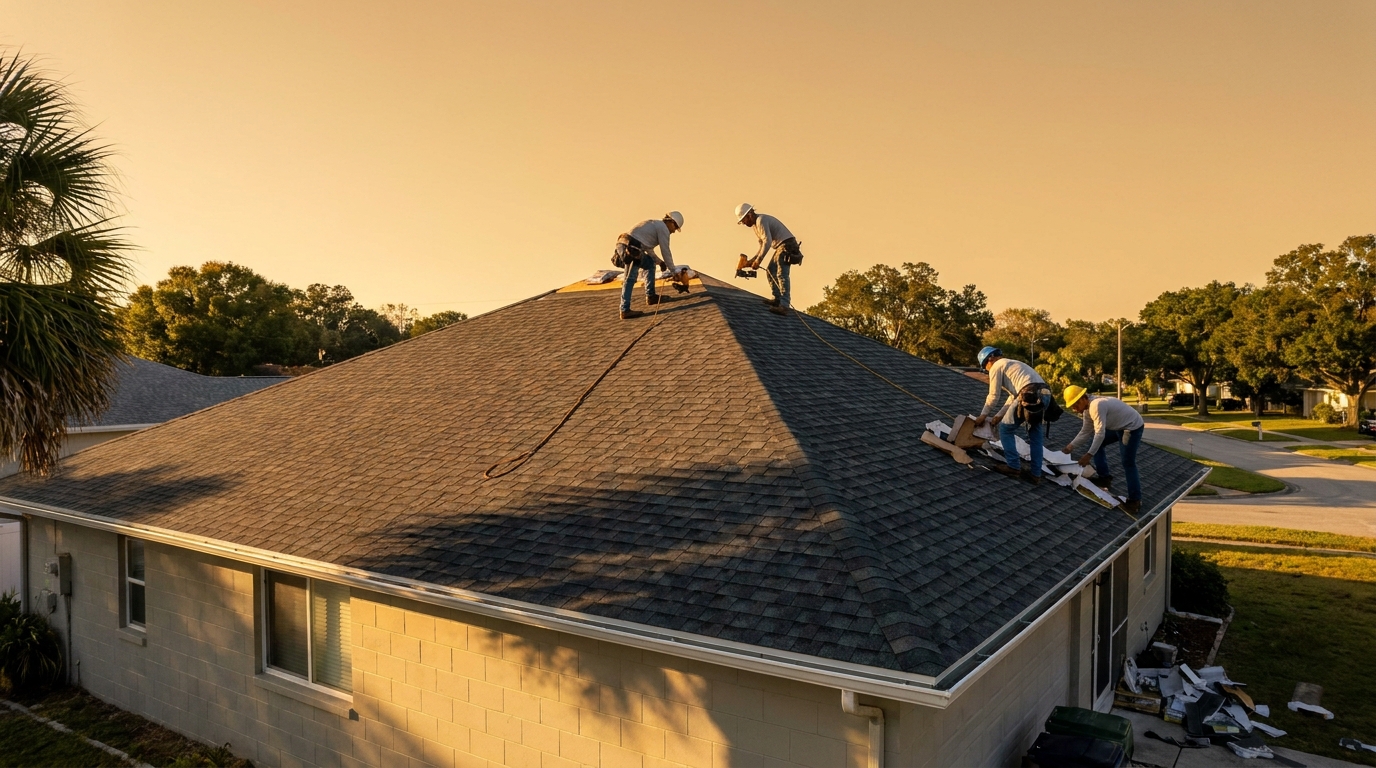
- Don't let old material cover new. Reputable installers remove the existing roof down to the deck before installing a new one, rather than roofing over.
- Florida's high-wind zones require architectural shingles to be fastened with six nails per shingle rather than the standard four — a code-driven install detail your contractor should confirm in writing.
How is wind mitigation different from the City permit?
A wind mitigation inspection is an insurance process, not a City process. It is governed by Florida Statute § 627.711 and produces a uniform mitigation verification form that insurers use to calculate hurricane-related premium discounts. It does not substitute for the City of Clearwater building permit or the City's required inspections, and the City cannot close out your roof based on a wind mit form.
In practical terms, the City permit answers: "Is this roof built to code?" The wind mitigation inspection answers: "How much credit does your insurer owe you for the features of that roof?" Items like roof deck attachment, roof-to-wall connections (clips, single wraps, double wraps), roof geometry, and secondary water resistance all drive the discount. A new, code-compliant roof almost always produces a better mitigation form than the one it replaced — which is why most Clearwater homeowners schedule a wind mit inspection shortly after the City finals the permit.
How do Clearwater's rules differ from unincorporated Pinellas County?
The jurisdictions are genuinely separate, which is the single most common source of confusion for Clearwater homeowners.
Several roofing rules published by the County apply to unincorporated Pinellas and its partner communities, not to City of Clearwater addresses. They are worth knowing because contractors often work across both jurisdictions:
| Requirement | Unincorporated Pinellas County | City of Clearwater |
|---|---|---|
| Permitting authority | Pinellas County Building & Development Review Services | City of Clearwater Planning & Development Department |
| In-progress roofing inspection | — | Follow the inspections listed on the issued City permit |
| Re-roofing mitigation affidavit on site | Required at time of final inspection | Confirm with City Building Services |
| Shingle wrapper on site at final | Required due to varying stagger patterns | Confirm with City Building Services |
| Wind mitigation form (insurance) | Governed by Florida Statute § 627.711 statewide | Governed by Florida Statute § 627.711 statewide |
If your downspouts currently tie into storm drainage on an unincorporated-county parcel, that's a separate issue worth addressing while a crew is already on the roof.
What about storm-damage roofs and after-the-fact permits?
Those two rules are published by the county and apply inside the county's jurisdiction; homeowners in incorporated cities should confirm their city's own storm-recovery permitting posture directly with their local planning and development department.
How should Clearwater homeowners time the work?
Plan the permit and the replacement around hurricane season. SCM Roofing, LLC recommends Florida homeowners schedule roof inspections twice per year — once before hurricane season in June and once after it ends in November. That cadence gives you time to catch problems early, pull permits in the slower spring window, and have a finished, mitigation-eligible roof before the next storm cycle.
That applies to the County's jurisdiction, not the City of Clearwater, but it is a reminder that Florida's permitting fee structure is actively moving. Confirm current fees with the permitting authority for your specific address before budgeting.
What homeowners say about the permit-handled approach
After the recent hurricanes damaged our roof, I went online to find a highly rated Tampa roofer. SCM was both highly rated and reasonably priced so I went with them and was very satisfied. From beginning to end, their rep (Robbie) was very helpful in explaining the different options, providing a contract and making sure the job got done right. When rain forced a delay in starting, he was proactive in informing us and rescheduling the job. With a two-story house, it’s hard to view the completed work up close, but the crew gave every impression that they knew what they were doing, and they very carefully cleaned up afterwards. The final bill was precisely what the estimate stated. Couldn’t ask for better service!
Frequently asked questions
Who pulls the roof replacement permit in Clearwater — the homeowner or the contractor?
The licensed roofing contractor pulls the permit in almost every case, submits it through the City of Clearwater's Planning & Development Department, and is responsible for posting it at the job site and calling in inspections. Homeowners who hire a contractor should never be asked to pull the permit themselves — if that request comes up, treat it as a warning sign that the contractor may not be properly licensed for the work.
Is a wind mitigation inspection legally required after a Clearwater roof replacement?
No Florida law requires a homeowner to obtain a wind mitigation inspection after a roof replacement. It is governed by Florida statute as an insurance tool — the uniform mitigation verification form is used by insurers to determine premium discounts. Whether your specific insurer requires or rewards one depends on your policy, so confirm with your carrier before and after the re-roof.
Does Pinellas County issue roof permits for homes inside Clearwater city limits?
No. If your property address is inside Clearwater, the permit goes through the City of Clearwater's Planning & Development Department regardless of how close your neighborhood sits to a county-served community.
What happens if I replace my Clearwater roof without a permit?
Work performed without a required permit, or contrary to approved plans, may prompt City of Clearwater code compliance enforcement. Beyond enforcement, an unpermitted roof can create problems with homeowner's insurance claims, title transfers, and future permit applications on the same property. The safer path is to confirm the permit is open and posted before the first shingle comes off.
How long is a Clearwater roof permit good for?
A City of Clearwater permit may become invalid if the authorized work is suspended or abandoned for six months or more without a successful inspection. For a typical residential re-roof that runs a few days once the crew mobilizes, this is rarely a practical issue, but it matters if weather, insurance delays, or material shortages push the start date well past permit issuance.
Will a new roof lower my Clearwater homeowner's insurance premium?
Often, yes — but the discount comes from the wind mitigation form, not the permit itself. A new roof with updated deck attachment, improved roof-to-wall connections, and a secondary water barrier typically produces a better mitigation verification form, which the insurer uses to calculate hurricane-related credits. Have a licensed inspector complete the uniform mitigation form after the permit is finaled and send it to your carrier.
The bottom line for Clearwater homeowners
Treat the City of Clearwater building permit and the Florida wind mitigation inspection as two separate boxes that both need to be checked — one for legality, one for insurance economics. Hire a Florida-licensed roofing contractor who pulls the permit in their name, follows the Florida Building Code as Clearwater enforces it, and finalizes the inspections before the crew leaves your driveway.
Homeowners in Clearwater who want this handled start-to-finish can reach SCM Roofing, LLC — Florida state contractor license CCC1331132 — at (855) 726-7663 or https://scmroofingfl.com to get the permit pulled, the roof installed, and the mitigation paperwork lined up for the insurer.